
Vienna, December 4, 2025
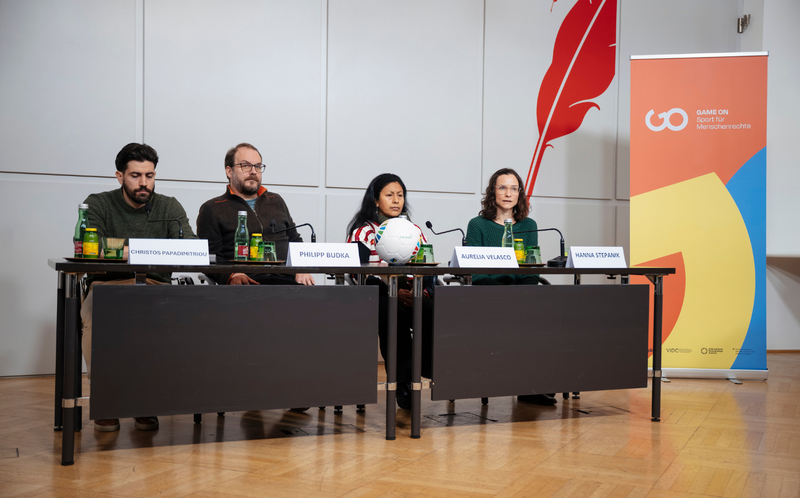
On December 5, the group draw for the 2026 FIFA World Cup will take place in Washington, D.C. What at first glance appears to be a tournament in democratic countries reveals a number of human rights abuses upon closer inspection. The day before the draw, the new Austrian initiative “GAME ON! Sport for Human Rights” was presented in Vienna, an alliance of 15 organizations from the fields of civil society, media, and sports. GAME ON! wants to highlight clear responsibilities and calls for the implementation of a human rights culture in sports. Experts report on the situation in the three host countries and the responsibilities surrounding major sporting events.
From June 11 to July 19, 2026, the Men's World Cup will take place in Canada, Mexico, and the USA. Following criticism of human rights violations at the 2018 World Cup in Russia and the 2022 World Cup in Qatar, FIFA promised to take more responsibility. The 2026 World Cup is the first men's World Cup with a published human rights strategy, which is being touted as a new benchmark for sporting events worldwide.
Hanna Stepanik, project manager and initiator of the “GAME ON!” project at the fairplay Initiative at the Vienna Institute for International Dialogue and Cooperation (VIDC), points out that the positive development that has emerged over recent years, with major sporting events such as the 2022 FIFA World Cup increasingly being reported from a human rights perspective, must be maintained, regardless of the country in which a mega-event takes place: “Anything else would be hypocritical! Because even in countries like Canada, Mexico, or the US, there are many issues from a human rights perspective. In the US, the situation surrounding immigration policy and freedom of the press and expression is coming to a head, Mexico is seeing record high rates of femicide, and in Canada we are seeing drastic setbacks in the protection of indigenous rights.”
Jennifer Li is the coordinator of Dignity 2026, a US-based coalition of 16 local, national, and international civil society organizations working to promote human rights and labor rights at the 2026 FIFA World Cup and addressing a variety of risk areas, including worker health and safety, discrimination, housing and displacement, and immigration. "The fact that the largest World Cup ever will take place in North America next year—amid a U.S. legal and political landscape in turmoil—is a call to action for FIFA, host cities, and host committees to take every possible measure to ensure that they fulfill both international human rights duties and domestic obligations to prevent and mitigate human rights abuses. Workers, people who are experiencing homelessness, immigrants, children, and other individuals at risk of adverse impacts from the tournament should not shoulder the highest costs of hosting the World Cup in an event where FIFA is projected to make well above $11 billion in revenue."
Aurelia Velasco plays as a defender for FC Los Andes in Vienna. As a member of the Mixtecos from Tlaxiaco (Oaxaca state), women's rights and indigenous rights are particularly close to her heart. She is particularly critical of the exoticization and commercialization of indigenous groups that often accompany major events such as the FIFA World Cup: “The cultural wealth of indigenous peoples always benefits the wealthy, while the affected population remains stuck in poverty.”
Philipp Budka, a cultural and social anthropologist at the University of Vienna who has been researching in and about Canada for almost 20 years, also takes a critical view of the supposed inclusion of indigenous communities in the FIFA World Cup. "Indigenous communities in Canada are culturally extremely diverse, but to this day they live with the consequences of colonial policies – including lower life expectancy, high suicide rates, and unresolved problems with water, energy, and transport infrastructure. Against this backdrop, it is clear that symbolic recognition in the context of the World Cup is not enough: Indigenous communities are demanding a genuine say and decisions that meet their needs and reflect their realities in the long term. The central question is therefore whether such a major event can contribute to greater justice or whether it is more likely to reinforce existing inequalities."
Christos Papadimitriou, former professional soccer player and head of marketing for the Austrian players' union Vereinigung der Fußballer (VdF), concludes by acknowledging the important role of human rights in sport: "As representatives of the players, it is our job to protect their rights. This includes fair working conditions, co-determination, and the freedom to take a stand without fear of negative consequences. Human rights are not a marginal issue in soccer, but the foundation of a safe and respectful working environment. That is why we also expect international associations to involve independent players' unions and to make decisions transparently and in the interests of the players.“
Austria-wide campaign
Under the motto ”GAME ON! Sport for Human Rights," actors from civil society, sports, and the media are advocating for democratic sports for all. In the run-up to the World Cup in Canada, Mexico, and the US, the initiative will take a close look at the human rights situation in the three host countries, provide regular background information, and raise broad awareness for a culture of human rights in sport. Football clubs, sports associations, and fans will be involved, as will young people and migrant communities. The diverse measures include action days with sports clubs, film screenings, training courses for sports journalists, a Club 2x11 panel discussion, an art event at the WUK, the Südwind Speaker's Tour through Austria, and a workshop program for young people.
The initiative will also leverage international synergies to jointly advocate for sports that promote human rights and do not violate them.
“GAME ON! Sport for Human Rights” is led by the fairplay initiative at the VIDC and implemented with partners Südwind, Oscar Sánchez, Frauen*solidarität, Vereinigung der Fußballer (Austrian Player Union), FC Los Andes, Austrian League for Human Rights, Protect Our Winters Austria, solidar, ballesterer, LEFÖ, Center for Canadian Studies, Reporters Without Borders Austria, and Africa Global Radio.
The initiative is significantly funded by the Austrian Development Agency.
Questions & contact:
Hanna Stepanik, Project Manager
fairplay Initiative
VIDC - Vienna Institute for International Dialogue and Cooperation
+43 1 713 35 94-66
stepanik [AT] vidc [DOT] org
https://www.fairplay.or.at/projekte/sport-fuer-globale-gerechtigkeit-menschenrechte
Press photos will be available here: https://www.fairplay.or.at/presse/pressefotos
